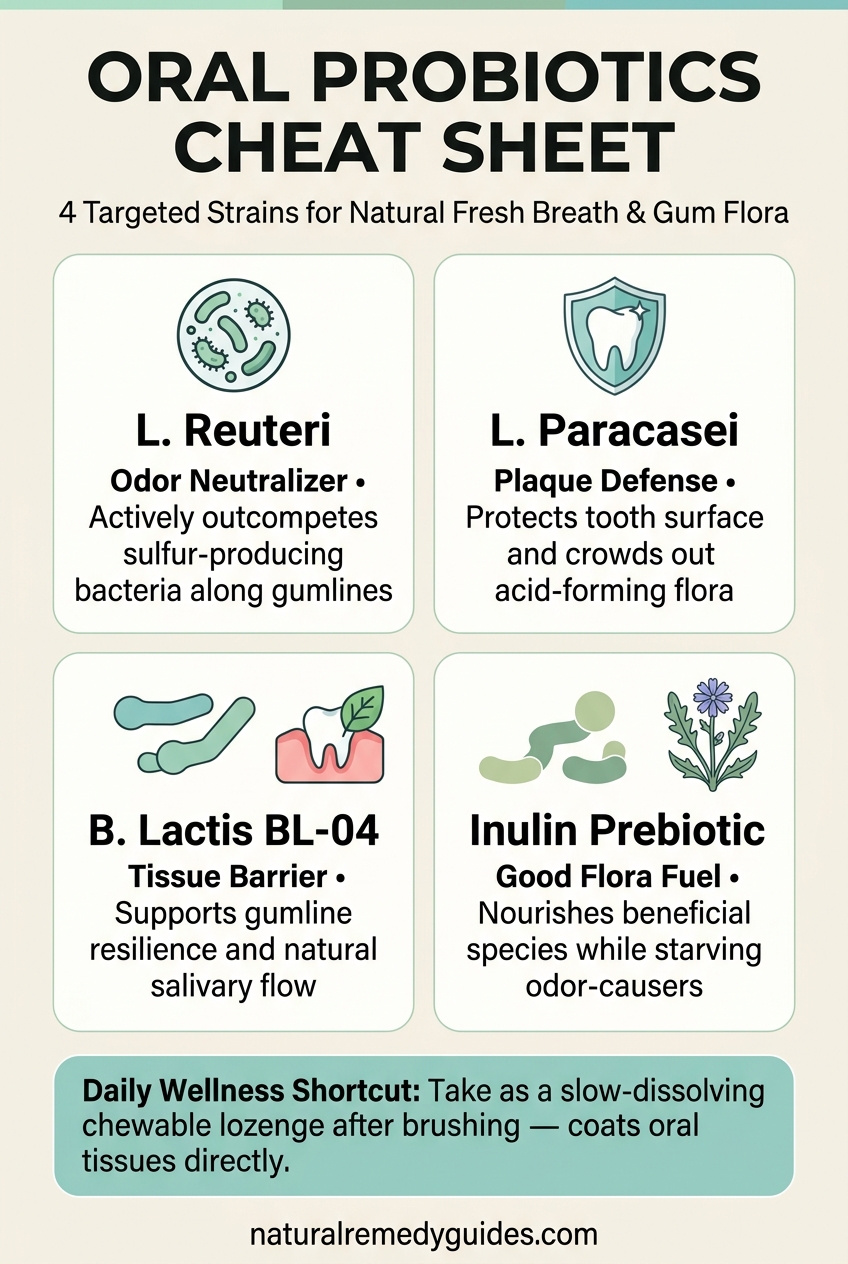
What it is: Oral probiotic lozenges are slow-dissolving tablets delivering billions of beneficial bacteria directly into your mouth — coating gums, tongue surface, and dental crevices to naturally support a balanced oral microbiome.
Does it work: Yes, particularly for individuals whose breath feels stale despite diligent brushing. When the challenge is an imbalance in natural oral flora, rebalancing the microbiome provides sustainable, root-level support.
The research: Peer-reviewed nutritional studies demonstrate that specific oral strains — especially L. reuteri and L. paracasei — help support natural moisture, maintain gumline wellness, and crowd out odor-producing anaerobic bacteria over 4 to 8 weeks of consistent use.
Verdict: ProDentim delivers 3.5 billion CFU of targeted oral strains in an easy, dissolvable daily lozenge. Backed by a 60-day money-back guarantee, it offers an evidence-informed natural addition to your daily wellness routine.
Using oral probiotics for bad breath is now one of the most evidence-supported approaches for the millions of people who brush twice daily, floss religiously, and still wake up to an embarrassing cloud of morning breath. If that sounds like you, this isn't a hygiene problem — it's an ecosystem problem.
Here's the painful irony: the harder you fight with mouthwash, the worse the cycle can become. Alcohol-based rinses strip your mouth of moisture and kill bacteria indiscriminately. That temporarily freshens breath, but the dry, oxygen-depleted environment left behind is exactly what anaerobic, sulfur-producing bacteria love. They repopulate faster than the beneficial species, and within hours you're back where you started.
Your mouth isn't a floor to bleach. It's a living ecosystem of over 700 bacterial species — and who dominates that ecosystem determines whether your breath is fresh or foul.
Ready to Rebuild Your Oral Ecosystem — Not Just Mask It?
Check ProDentim Official Pricing & Packages →Backed by a 60-day 100% money-back guarantee • 3.5 billion CFU per lozenge
Why Oral Probiotics for Bad Breath Work When Mouthwash Doesn't
Bad breath — clinically called halitosis — originates primarily from anaerobic bacteria like Porphyromonas gingivalis and Treponema denticola that live in the oxygen-poor crevices between your teeth, under your gumline, and in the grooves of your tongue. Their metabolic waste products are volatile sulfur compounds (VSCs): hydrogen sulfide, methyl mercaptan, and dimethyl sulfide. These are literally the same compounds that make rotten eggs smell the way they do.
Mouthwash creates a 30-minute reprieve. Oral probiotic lozenges pursue a fundamentally different strategy: they introduce beneficial species that compete for the exact same binding sites on gum tissue and tongue surface that sulfur-producers occupy. When good bacteria win those territorial battles — and hold them — VSC production drops and stays down.
The lozenge format matters enormously here. Unlike gut probiotic capsules that are engineered to survive stomach acid and reach your intestines, oral lozenges dissolve over 10 to 15 minutes, releasing billions of live bacteria directly into saliva where they coat every surface in your mouth. Gut capsules never interact with your oral environment at all — they were never designed to.
The 4-to-8 Week Timeline: What to Expect
Rebuilding an ecosystem isn't instant — and that's actually a good sign. Sustainable freshness comes from population-level microbiome shifts, not chemical suppression.
- Weeks 1–2: The lozenge dissolves daily, coating gums, tongue, and dental crevices. Beneficial strains begin establishing initial colonies and competing for binding sites.
- Weeks 3–4: VSC-producing anaerobes begin losing territorial ground as good bacteria populations strengthen. Some users notice intermittent freshness improvement.
- Weeks 6–8: The ecological shift becomes measurable. Consistent users in clinical trials showed statistically significant reductions in VSC readings and self-reported halitosis scores at this window.
ProDentim Strains & Ingredients: Clinical Breakdown
| Ingredient / Strain | Biological Role | What It Does for Your Breath | Clinical Evidence Level |
|---|---|---|---|
| L. reuteri | Produces reuterin — a broad-spectrum natural antimicrobial | Occupies gum binding sites, directly displacing sulfur-producing anaerobes | RCT-level (PMID 16827877) |
| L. paracasei | Beneficial oral commensal bacteria | Competes against Streptococcus mutans and plaque-forming biofilm species | Multiple clinical studies |
| B. lactis BL-04 | Bifidobacterium with affinity for gum tissue | Supports healthy gum barrier, reducing anaerobic pockets where VSC producers hide | Dental RCT data |
| Inulin (Chicory Prebiotic) | Soluble fiber — selective bacterial food source | Feeds allied probiotic species exclusively; starves sulfur producers that cannot metabolize it | Bifidogenic studies |
| Malic Acid | Natural fruit acid found in apples | Stimulates salivary flow — your mouth's own natural defense and self-cleaning mechanism | Salivary flow studies |
ProDentim Oral Probiotic: Honest Pros & Cons
What We Like
- Targets the biological root cause (VSC-producing anaerobes) rather than masking odor with fragrance
- Slow-dissolving lozenge format delivers bacteria directly at the oral source — not via gut absorption
- 3.5 billion CFU of clinically studied oral strains per tablet
- Inulin prebiotic actively feeds beneficial strains for sustained colonization
- Malic acid supports natural salivary defense alongside the probiotics
- Backed by a 60-day money-back guarantee with no difficult return process
What to Keep in Mind
- Requires 4–8 weeks of consistent daily use for full microbiome shift — not an overnight fix
- Only available through the manufacturer's official website
- Works best alongside (not instead of) regular brushing and flossing
- Not a substitute for professional dental treatment of active gum disease
Who This Is NOT For
- People expecting overnight results: If you need fresh breath in the next two hours, reach for a mint. Oral probiotics are a 6-to-8-week biological project.
- Those with active, untreated gum disease: Clinical periodontitis creates deep anaerobic pockets that need a periodontist first. Probiotics support maintenance, not emergency treatment.
- Heavy daily smokers: Tobacco continuously disrupts oral microbiome balance and creates conditions that resist beneficial colonization.
- Anyone expecting a replacement for brushing and flossing: Oral probiotics are an addition to your hygiene routine, not a workaround for skipping it.
If none of those apply to you and your bad breath has stubbornly resisted every mouthwash and mint you've tried, you're likely dealing with a true ecosystem imbalance — and that's exactly the problem oral probiotics are designed to solve.
Stop Masking Bad Breath — Start Fixing the Ecosystem Behind It
Order ProDentim from the Official Website →60-day money-back guarantee • 3.5 billion CFU oral probiotic lozenge • Free shipping on multi-bottle orders
Frequently Asked Questions About Oral Probiotics for Bad Breath
Why don't regular gut probiotic capsules work for bad breath?
Gut probiotic capsules have enteric coatings specifically designed to survive stomach acid and reach your intestines — they never interact with your oral environment at all. Oral probiotic lozenges dissolve slowly in your mouth, delivering billions of beneficial bacteria exactly where the problem lives: along gumlines, on tongue coating, and in dental crevices. The delivery format is the whole point.
How is this different from using probiotic yogurt for breath?
Fermented foods primarily contain L. acidophilus strains selected for gut colonization, not oral biofilm competition. They also pass through your mouth in a matter of seconds — nowhere near enough contact time to establish colonies. ProDentim contains specifically selected oral-ecosystem strains (L. reuteri, L. paracasei, B. lactis BL-04) in a slow-dissolving lozenge format that maintains live bacteria in contact with gum tissue for 10 to 15 minutes per dose.
Can oral probiotics really change established bad breath or is this too good to be true?
The science is solid — but it requires honest expectations. Peer-reviewed clinical trials show statistically significant reductions in VSC levels over 4 to 8 weeks of consistent daily use. Results are gradual because you're rebuilding a microbial ecosystem rather than chemically suppressing it with antiseptics. Think of it like reseeding a lawn: it takes weeks, but once established, it crowds out weeds naturally. Best results consistently come from maintaining regular brushing and flossing and adding the daily oral probiotic.
Scientific References & Research Context
- Archives of Oral Biology: Keller MK, et al. Systematic review — oral probiotics alleviate halitosis by reducing volatile sulfur compound levels across multiple study populations (PMID: 34068264).
- Journal of Oral Microbiology: Morales A, et al. Probiotics reduce halitosis through direct biofilm modulation and competitive exclusion of anaerobic VSC-producing species (PMID: 35165747).
- Journal of Clinical Periodontology: Krasse P, et al. Lactobacillus reuteri reduces inflammatory gingival markers and volatile sulfur compound readings in a double-blind study (PMID: 16827877).
Educational & Wellness Disclaimer: This guide is prepared for informational and educational wellness purposes only. Natural Remedy Guides does not provide medical or dental advice, diagnosis, or treatment. Dietary supplements are intended to support general oral wellness and do not replace professional dental cleanings or care.
FDA Disclaimer: These statements have not been evaluated by the Food and Drug Administration. This product is not intended to diagnose, treat, cure, or prevent any disease.
Independent Wellness Research & Editorial Standards
Our Wellness Research Approach: We explore publicly available scientific literature, nutritional research, botanical studies, and traditional wellness practices to help readers understand natural supplements and healthy lifestyle habits. Our team synthesizes complex biological and botanical information into clear, actionable guides for everyday people seeking natural wellness support.
Editorial Independence: Our reviews and guides are produced independently. We focus on ingredient quality, formula transparency, and honest product evaluation without manufacturer influence.
Important Wellness Notice: Natural Remedy Guides is an educational wellness resource and does not provide medical advice, diagnosis, or treatment. Dietary supplements are not intended to diagnose, treat, cure, or prevent any medical condition. Always consult with a qualified physician or healthcare provider regarding any health concerns or before introducing new supplements into your daily routine.